Senin, 07 Oktober 2013

Weekly Forex Market Chart Analysis – October 7th to 11th 2013


By Nial Fuller   Posted in Forex Trading Commentary   

EURUSD – Euro/dollar retraces back to dynamic support

The EURUSD retraced down into the 8 day EMA dynamic support level on Friday as the uptrend takes a breather. Overall, the trend is still up and we can clearly see bullish momentum dominating the daily chart below. This week, we will be watching for price action strategies to buy from support in order to trade back in-line with this uptrend. If the market rotates down toward the 21 day EMA and the near-term support between 1.3460 – 1.3400 we would definitely be watching the 4 hour and daily charts for buy signals. Key longer-term support is seen down around 1.3100 area.
euro1
GBPUSD – Sterling/dollar sells off from key resistance
Last Tuesday, a small counter-trend pin bar formed in the GBPUSD, and if you zoom out to your weekly chart you can see this pin bar whilst small, occurred at a key longer-term weekly resistance level up near 1.6300 that price has been unable to break through over the last couple of years. Thus, because the pin bar formed at this very important / key resistance level, it is not surprising to see the large sell-off that we saw on Thursday and Friday of last week even though the pin bar itself was a bit smaller than we’d like. Price is now facing some near-term support down near 1.5955 that could cause the recent uptrend to resume if we can get some bullish price action forming near that support.
sterling2
AUDUSD – Aussie/dollar strength continues
The AUDUSD has remained buoyant since September 30th when it re-tested the key support zone that starts down near 0.9300. This week, we see the potential for more strength in this market if it continues to hold above 0.9300 – 0.9220 key support zone. Traders can continue to look for price action buy signals as this market retraces back to support in order to trade in-line with the recent uptrend in this market.
aussiedollar3
Gold – Spot Gold trading just above key support
The Spot Gold market has been trending lower recently and we can see in the chart below there’s a very important / key support level coming in close below around $1275.00. If the market holds above this level this week we could eventually see it make a run higher. However, if the market keeps trending lower and closes below this key near-term support we could see a larger move lower as the next key support is not seen until down around $1180.00.
gold1

Rabu, 11 September 2013

The “Four Horsemen” That Are Killing Your Forex Trading

By Nial Fuller   Posted in Forex Trading Education Articles   

the four horsemen
You’ve probably heard of the “Four Horsemen of the Apocalypse”, while I’m not going to give you a “sermon” today, I amgoing to talk to you about the “Four Horsemen” of your trading account “apocalypse” and how to defeat them. They are the four emotions that influence most trader’s decision making in anymarket: Greed, Fear, Hope and Regret, and if you don’t thoroughly understand them and keep them under control, they will KILL your trading account, in shall we say an “apocalyptic” manner…

Let’s take a closer look at the “Four Horsemen” of your trading account’s “apocalypse” and how they work to influence your decisions in the market and how to control them instead of being controlled by them…

GREED

Greed is something we are all familiar with; it is the excessive desire for money and wealth (or other things). However, as it relates to trading, it can be more specifically defined as expecting an unrealistically large or quick profit from a trade.
Risking more than you know you should on a trade is the perhaps the most obvious way that greed negatively affects traders. You need to define the 1R dollar risk per trade that you are comfortable with potentially losing on any given trade, and never exceed that amount. If you start ratcheting up the amount you’re risking, you are being greedy, and it only takes one losing that you’ve risked too much on to do serious damage to your trading account.
greed
When traders get greedy they may not even be aware of it. It often manifests as looking at your open profit on a trade and thinking about how much you’ve made and about how much more you ‘could’ make by keeping the trade open. Here’s the danger with this line of thinking: Open profit is just that, “open”, and you have not secured any profit from a trade until the position is closed. Unless you have closed a profitable position out, you really have nothing but the potential for profit. Traders often confuse the feeling that they get by looking at their open profit on a trade as ‘real’ money that they already have ‘in the bank’. Ignoring the fact that open profit is much different than ‘secured’ profit is the root cause of why traders do things like move their original profit target further away as price approaches it, which typically results in a much smaller profit than their original target would have brought them, or no profit at all. If you are greedy in trading, it has the ironic effect of making profits harder to obtain.

If you had a predefined profit target set at a 1:2 or 1:3 risk reward ratio, but as price gets close to that target you move it further away because you “think” price will keep going for an even bigger gain…that is greed, and it will almost always result in you making LESS than you would have if you just exited at your predetermined profit target. It can be difficult to exit a trade when it “looks good” and is in your favor, but most of the time, that is precisely when you should be exiting. Many traders hold trades too long, move their targets further out or set unrealistically large profit targets. All of these things are the result of GREED and they will all result in you making less money than if you weren’t greedy.
Greed can help you amass money in some areas of life, like if you are a “cheap” person who doesn’t like to spend much money…while this personality trait obviously has other negative consequences, it will help you grow your bank account over time. However, greed in the currency markets or in any investment / trading market will work against you most of the time and it’s something you must consciously be aware of and fight if you want to have a chance at long-lasting trading success.

FEAR

fear
Many traders struggle with fear at some point, and they also get abused by it. Let me explain…

Fear can be both good and bad in trading, unlike greed which is essentially always bad for a trader. Fear is an extremely powerful emotion, perhaps THEE most powerful of all emotions we experience. Fear of death and other consequences keeps us (most of us) from doing stupid things like driving drunk or trying to wrestle a crocodile. Fear is essentially a survival response, and this can be good if you were a caveman trying to escape certain death from a saber-toothed tiger. However, in modern day financial markets, fear can cause all kinds of problems for traders…
First off, fear of losing money can be both good and bad, you just need to find the right balance and not have too much fear. Fear of blowing out your trading account will cause you to place stop losses on all your trades, thus, in this regard fear is good for the trader. But, fear can work against us too, by causing us to not enter a good price action trade setup only because we are “afraid” of losing money, perhaps because we’ve just had a series of losing trades. The other main reason traders become afraid to trade is because they have been risking too much money per trade and have just lost more than they can stomach. Thus, there are two main points to be aware of that can help you curb the negative effects of fear:
1) Your last trade has no effect on your next trade. If you are following your trading strategy, you will have winners and losers scattered about in a random distribution. Thus, you should not let your previous trade results (good or bad) influence your next trading decision.
2) You must find a dollar amount that you are comfortable with risking per trade. If you are risking too much money and gotten burned a couple times doing so, it will quickly cause you to be afraid of the market.
YOU have the power to control your own fear in the market. You should be a little bit afraid, because you can lose all your money if you let the market take it. But, the great part is that if you are aware of this and act accordingly, by properly managing your money and sticking to your trading strategy, you can find the right amount of fear and not let excessive fear derail your trading efforts.
Also, listening to news and economic reports (fundamental analysis) can induce fear into traders’ minds. News can cause traders to rationalize why they should close a trade or enter a trade, regardless of what the price action is saying. This is very wrong. The price action is all that really matters, and anything that can affect a market will be reflected in its price action, so following news reports and analyzing them is really a waste of time that can easily cause you to become fearful for no reason.

HOPE

hope
Hope is dangerous for traders. It can be hard to understand this one, because ‘hope’ is usually thought of as a very good thing, and it is in most instances, just not in trading.

Hope is essentially the expectation that something will happen or a strong desire for it to happen. When traders trade with “hope”, they often ‘hope themselves’ right of making money. Hope can cause traders to move their stop losses further away or delete them all together because they think the market will turn around in their favor, allowing them to avoid the losing trade. Hope works in tandem with greed when traders hope for an unrealistically large profit and move profit targets further out. This typically ends up with the trader taking a very small profit because they never take the profit when it’s at a decent dollar amount in their favor, because they “hope” it will keep going and going.
Hoping that every trade you take will be a winner is foolish. When a trader “hopes” for a winning trade they are also expecting a favorable outcome, and this sets them up for whole host of emotional trading errors because when you expect something to happen and it doesn’t, it typically makes you sad, angry or regretful. It is much better to simply take a realistic view on every trade, and that means understanding that whilst you might have an effective trading strategy, that does not mean every trade will be a winner. You will have a mixture of winners and losers, and hopefully, over time if you manage your money properly and do not over-trade, you will see the “edge” that your trading strategy gives you, pay off. Thus, it would make far more sense to “hope” for aprofitable trading year IF you follow your strategy and implement consistent discipline in your money management, rather than “hoping” that every trade is a winner, because then you are hoping for something that is not realistic.

REGRET

regret
Regret is the feeling that traders often feel after a losing trade or a missed trading opportunity or perhaps after not making as much money as they hoped they would on a trade…possibly due to greed and fear, as we discussed above. Regret can slowly destroy your trading account……

From the emails I read each day, I know that many traders focus too much on past trades and “what if” scenarios. Something that you need to understand is that NO two moments in the market are exactly the same, thus it’s mostly a waste of time to stew over lost trades or that you didn’t make as much money as you could have. You can’t change what happened on your last trade, all you can do is evaluate what happened and try to take a little something away from it and move on. It is far more important to be focused on the “now” of the market rather than the past, because the market is constantly ebbing and flowing and it does not care how much you made or lost on your last trade.
Regret also causes traders to “chase” trades by jumping in the market after a setup has already triggered. This gives them a far worse risk reward potential on the trade which makes it a lot harder to turn a profit on the trade, chasing trades is not how a skilled and patient trader behaves. Instead of being regretful over missing a trade setup, the professional trader will simply remain calm and observe the market, learn a little something, and keep his or her hands in their pockets until the next trade comes along. Chasing trade setups is a VERY slippery slope to forgetting about your trading plan and kicking off the process of trading randomly or gambling in the market.

Conclusion: How to defeat the “Four Horsemen”

master your trading emotions
Since we are human, we are all susceptible to the same types of emotional trading mistakes, and the ones I’ve discussed in today’s lesson are the most common. To effectively battle them, the first step is being aware of them and their implications, which you’ve learned here today. The next step is to catch yourself “in the moment” and consciously become aware that you are being greedy, afraid, hopeful or regretful, and then quite frankly, kicking the emotional enemy in the ass.

Tackling your emotional trading enemies takes effort and patience; there’s no ‘free lunch’ in trading, and being unaware of this fact is perhaps why a lot of people fail it. If you make an effort to become more self-aware as you trade and gauge how you are feeling and consciously try to control how those feelings affect you, you will be far ahead of most traders. I cannot force you to do these things or pay attention to what I’ve said here today, but I can promise you that if you work to fight these “Four Horsemen” that are killing your trading, and combine that battle with effective trading strategies like those I teach in my price action trading course, you will avoid a trading account “apocalypse” and put yourself on the road to a successful trading career.

Kamis, 29 Agustus 2013

How To Draw Support and Resistance Levels Like A Professional

By Nial Fuller   Posted in Forex Trading Strategies   

support and resistance levels
In my daily Forex commentary each day, I draw in the key levels of support and resistance that I feel are the most significant in the current market environment. It’s something that I’ve done for so long it really only takes me a few minutes to do now, it really is a very logical and simple task for me and it can be for you too.

Many traders make the process of drawing support and resistance levels a lot more difficult than it needs to be. After you have a general idea of how I draw my support and resistance levels, you should have no problem using that knowledge as a guideline to draw the levels yourself. We get tons of emails each week from traders asking how to properly draw support and resistance levels on their charts. Also, we get emails with chart attachments from traders who are clearly drawing far too many levels on the charts, thus complicating the process of price action trading and confusing themselves as well.
Today’s lesson is going to be a tutorial of how I draw my levels in the market. Basically, I’m going to take you guys on a ride through my brain (scary I know) as I decide where to draw support and resistance levels on some real-time daily charts. You can use this lesson as a reference until you feel comfortable enough drawing the levels on your own. Also, it will help you to make your own commentary each day of your favorite markets; writing down your analysis rather than keeping it all in your head is a good way to stay on track and make sure you have a clear plan for the week and day ahead. To get started, let’s clear up a few common myths about drawing support and resistance levels…
Common myths about drawing support and resistance levels:
Myth 1: You should draw every level you can find on your charts – Many traders fall into this trap, they end up taking an hour to draw on every little level they can find. What they end up with is a really messy chart that basically does more harm than good. You need to learn to draw only the significant levels on your charts, then you’ll have a useful framework to work from.
Myth 2: Your S/R (support and resistance) levels should always be drawn across the exact highs or lows of price bars – This is perhaps the biggest myth that traders have about drawing levels on their charts. Often times, support and resistance are more “zones” than exact “levels”, sometimes you will have a key level that is indeed an exact level, but more often than not we are going to be drawing our support and resistance lines midway through bar tails or even through the body of a bar sometimes. Point being, you don’t always have to draw the level exactly through the high or low of the bar. Note: if you are totally new and confused by some of the lingo here, please take some time to go over this candlestick tutorial before moving on.
Myth 3: You should go back really far in time with your levels – Unless you are a long-term buy-and-hold investor right now, you don’t need to go back more than about 8 months when drawing your levels. If you look at our free forex commentary you can see we really only focus on the last 3 to 6 months when drawing in the daily levels, and that goes for my own personal trading too. I am not sitting there trying to draw in levels from the last 5 years like some traders…you are wasting your time if you’re doing this.
OK! Now that we’ve cleared up those common myths about drawing S/R levels on your charts, let’s move on to some “meat”:
How I draw support and resistance levels on my charts:
Below are examples of how I would draw the relevant support and resistance levels on some of the major Forex pairs, Gold, Crude Oil and Dow Futures as they stand at the time of this writing. Above each chart is a brief explanation of why I drew the levels where I did.
Example 1: EURUSD DAILY CHART
Here we are looking at the current euro / dollar daily chart. You’ll note the red lines highlight the longer-term or “key” levels and the blue lines highlight the shorter-term or “near-term” levels. This is how all the examples will be in this lesson and hopefully it will make it easier for you to differentiate between what I often refer to as “key” levels from shorter-term levels that aren’t quite as significant.
In this example, you can see this market is clearly in a trading range right now between about 1.3140-70 resistance and 1.2830 support. Those are what I would call the “key levels” on this current daily EURUSD chart. Within the range, we have some shorter-term levels that are still significant albeit less so than the key levels just discussed. Of special note are the two shorter-term resistance levels marked on the chart below. You will see that the one near 1.3070 is hitting a bar high from October 5th, but also it’s going through the bodies and middle of the tails of the bars from October 17th – 23rd. This brings up a good point…a support or resistance level can be significant even if it isn’t exactly touching bar highs and lows. This is also seen at the key resistance of the range, note how the line through 1.3140 is not touching the exact highs on September 14th and 17th at 1.3171…this brings up the point that sometimes support or resistance is more of a “zone” than a strict / exact level. In this case the resistance of the current range is really a small zone of resistance from 1.3140 to about 1.3171 (more on support / resistance “zones” soon).
Also of note, there was an inside bar on October 18th, and after the market broke down from that inside bar it tried to rotate back up to about where it broke down at, and this breakdown level acted as resistance and held the market off from advancing further, and then as we can see the market has since fallen away from that level. These are some of the more subtle things you need to learn about when drawing in your levels…especially shorter-term levels; that inside bar breakdown point held as a resistance, and often inside bar breakout points will act as support or resistance, even if it’s just for the short-term.
Example 2: GBPUSD DAILY CHART
Here’s a good exercise for you to work on: When marking support and resistance levels on your charts, mark the longer-term “key” levels first and then draw the shorter-term levels. This will work to give you a framework for the current market conditions and gives your analysis some routine as well.
One of the things I often write about is support or resistance “zones”, as often a support or resistance is not really an exact level but more of a zone. In the example below, we can see a very good example of a resistance zone that occurs between about 1.6270 and 1.6310.
“Key” support or resistance levels are generally levels that price rejected forcefully and that gave rise to a significant move up or down, or they can be levels that have contained or supported price many times. Whereas, shorter-term levels give rise to smaller movements and tend to break easier. We can see good examples of both in the GBPUSD daily chart below:
Example 3: AUDUSD DAILY CHART
In this example we are looking at the AUDUSD daily chart and we can see currently the market is in a large trading range between about 1.0612 and 1.0175. We classify 1.0612 as “key resistance” since it has caused significant turning points in the market and held on the last two tests. Similarly, 1.0175 is “key support” because it has led to significant turning points in the market and held on about the last 4 tests. The shorter-term level through 1.0410 is clearly significant, but again it’s not “quite” as significant as the two levels just mentioned. As you can see, some of drawing in your levels and deciding which is more important than the other can be left up to your own interpretation, but at the same time you should have a logical line of reasoning such as “this level has held price more times”, or “that level created a larger move”, etc.
Example 4: USDJPY DAILY CHART
In the USDJPY example below, we are looking at all “key levels” because I did not see any that I considered to be short-term levels. The reason being, every level I’ve drawn in has created a significant turning point. The USDJPY most recently has been breaking higher, and if the resistance near 80.37 gives way we will likely see another leg higher.
Of special note in this chart are the bar tails or wicks. Note how some of the levels are not drawn exactly at the bar highs or lows but rather through the middle portion of the tail. This is important, and it’s one of the myths I mentioned at the start of this lesson; you don’t always have to draw your S/R levels exactly at a bar high or low. In fact, it’s more important to have a lot of tails touching a level than it is to have a level exactly at two or three bar highs or lows. An example of this is the level at 78.79 in the chart below; note how I drew it through as many bar tails (or wicks) that I could, rather than moving it further up and just hitting the exact highs of a couple bars. Drawing your levels in this manner gives you a better reference point to look for signals from since you are getting closer to the mean or average turning point price in the market, so it’s basically a higher-probability level than a level that’s further out but exactly at a bar high or low. That’s not to say you will never draw S/R levels at exact highs or lows, because you will, a lot, but it just means you don’t always have to draw them that way and won’t always want to.
Example 5: NZDUSD DAILY CHART
In the NZDUSD chart below we want to take note of what I refer to as a “value area”. Now, what I mean by “value area” is basically just an area where it’s obvious that price “likes” to be. This is essentially just another word for consolidation, since an area of consolidation on a chart is essentially where a market has found “fair value”. These value areas typically act as support or resistance zones, and this means when price retraces back to them you can watch for price action trading strategies forming at them. You will also sometimes have existing support or resistance levels that basically run right through the center of a value area, showing about the middle of the value area, and we can see this clearly by the blue line in the chart below. In this specific NZDUSD example that blue value line would be a good support to watch for buy signals if price rotates lower soon.
Example 6: USDCAD DAILY CHART
The USDCAD daily chart below shows us a good example of the “value” concept that I discussed in the last example. Note how price formed that area of consolidation or “value” marked on the chart below, and then later price retraced back up to it and found resistance exactly at the center of the value near 0.9883 on October 3rd. Then, after price finally broke back above that value level it formed a price action setup after it retraced back down to it, as we can see an inside pin barcombo setup formed showing rejection of that same level.
So, here’s a very simple strategy for you; wait for a key level to break, then wait for price to retrace back to it and look for a price action setup entry trigger to form near the breakout level in the direction of the initial breakout.
Example 7: EURJPY DAILY CHART
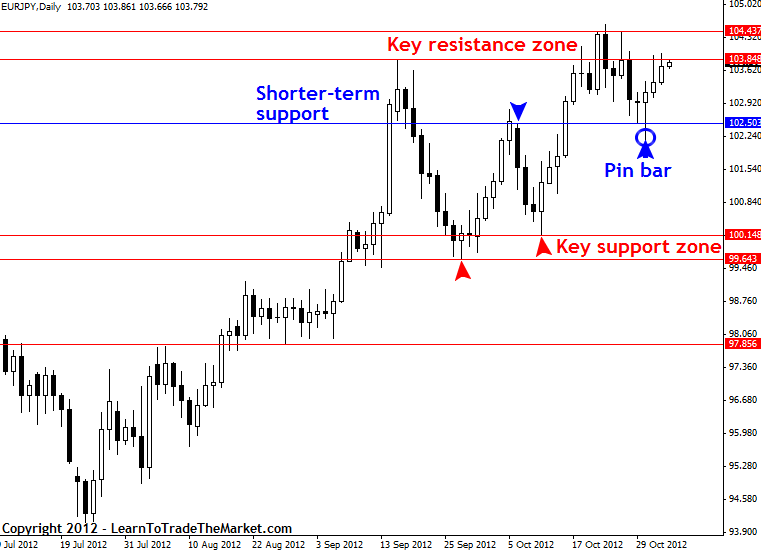
We can see in the EURJPY chart below that it’s been in an uptrend since about the end of July. This uptrend has had some pretty large counter-trend retraces, which of course we need to mark with levels. We can see in the chart below the support levels and zones left behind by the different points in the market were the retrace ended and the uptrend resumed. Also, in a trending marketlike this, we can watch the previous swing points for price action signals as the market retraces back to them. For example, in an uptrend we can look for price action entries at the previous resistance / swing points in the market which turn into support after price breaks up past them. We can see a clear example of this in the chart below with the recent pin bar trading strategy that formed at the shorter-term support through 102.50 area, note that this level was previous resistance.
Example 8: XAUUSD DAILY CHART
In the Gold chart below, you can see I’ve gone back about 8 months in drawing in my long-term levels. This is about the farthest back I typically go when drawing in my levels on the daily charts. Again, longer-term “key levels” are those levels that clearly caused a significant change of direction in price and / or held strong on multiple tests across time. Shorter-term levels are those that caused less significant price direction changes and may be “newer” levels. You don’t have to get carried away drawing in too many of the shorter-term levels though, just use common sense and decide which are the most obvious and draw those in. If you put too many support and resistance levels on your charts you’ll end up with a messy chart that just confuses you and might even cause you not to trade because you think there are too many levels for the market to have to move through.
This brings me to a very important point you should remember: In an up-trending market, resistance levels will often break, and in a down-trending market support levels will often break. I say that because I get a lot of emails from traders telling me they can’t get a proper 1:2 or morerisk reward ratio because there are too many support or resistance levels in the way. Well, you have to look at the market context that your trade setup has formed in and use some common sense and discretion…not every little level you find is significant.
Example 9: DJ30 DAILY CHART
In the Dow Jones futures chart below, we can see the current picture of key levels that are relevant for this market. Of special note, we can see how consistently these key levels hold as price retraces back to them. Knowing that price often bounces or repels from key levels is a very valuable piece of information. Indeed, a big portion of my trading theory revolves around waiting patiently for an obvious price action setup to form at a key chart level as the market retraces back to it. If you observe this chart for a few minutes, you’ll begin to see how accurate these levels are in rejecting, it really is uncanny.
Example 10: WTI DAILY CHART
In the example below, we are looking at the current Crude Oil chart. This chart shows us a very important lesson. Note the pin bar marked on the chart below, it was an obvious pin bar that showed forceful rejection of a key resistance level, and then the market chopped around about 6 days before finally moving lower. The most obvious stop loss placement on that pin bar would have been just above its high which was also the key resistance through $93.65 area. If you enter an obvious price action setup like that and you’ve placed your stop loss at a logical spot in-line with the existing market structure, there’s no reason to panic if the market moves against you and almost stops you out. This exact scenario was very likely in this Crude oil pin bar setup, and I know some traders who panicked when price moved against them. Had they just stayed in the market, their initial stops just above the key resistance would not have been hit and they would have made a killing. Lesson: trust your stops if you’ve placed them beyond a key support or resistance level or in another logical place.
Conclusion:
I hope you now have a better idea of how I draw support and resistance levels on my charts and why I draw them where I do. I suggest you try drawing the relevant levels on your charts now according to what you’ve learned in today’s lesson. Also, follow my daily Forex commentary for a good daily example of how I draw the levels on a major market each day.
Determining where to draw your support and resistance levels is really not as difficult as many traders make it out to be. When in doubt, slow down and take a step back, ask yourself if a level your about to put on your chart makes sense and why. If it makes logical sense you should be able to easily explain why to someone who has no trading experience. For example, you might say “This level is important because it clearly caused price to make a significant change of direction recently”. If you just take a logical approach to drawing in your support and resistance levels you will save yourself a lot of time and frustration in the end. Don’t be one of those traders with so many lines on their charts you can’t figure out what’s happening. 

Senin, 26 Agustus 2013

Fairuz Aqilah Peluw


Weekly Market Technical Analysis Outlook – August 26th to August 30th 2013

By Nial Fuller   Posted in Forex Trading Commentary   

EURUSD – Euro/dollar consolidating below key resistance
The EURUSD moved modestly higher on Friday after a pin bar formed on Thursday showing rejection of lower prices. Despite Thursday’s pin bar, the market still needs to overcome key resistance up near 1.3415 to have a chance at extending the recent rally. Unless the market can close decisively above 1.3415 on the daily chart time frame, we will probably see more consolidation this week or perhaps a rotation lower, back down toward support.
eurusd
GBPUSD – Sterling/dollar rotates down from pin bar at key resistance
The GBPUSD rotated lower last Thursday and Friday from the bearish pin bar reversal setup that we discussed in our August 21st commentary. There’s potential for this market to fall lower still this week, and perhaps re-test key support down around 1.5424. If you zoom out to the weekly chart you can see a bearish pin bar formed on the weekly chart last week, indicating that price could continue falling again this week.
gbpusd
AUDUSD – Aussie/dollar consolidating just below 0.9055
The AUDUSD moved lower again last week and was trading just below 0.9055 resistance late last week. If the market stays contained below that level, we could see it drift lower and re-test key support down near 0.8847 before bouncing higher again. Alternatively, if the market can close back up above 0.9055, we could potentially see it try to push higher again. Overall, this market appears to be a bit choppy right now and we could see some consolidation this week as the market continues to be range-bound between 0.9320 and 0.8847.
audusd
GBPJPY – Sterling/yen false-break pin bar at trading range resistance
The GBPJPY has been caught in a trading range between about 154.00 and 147.50 for about 3 months now. On Friday, the market tried to break out of this range but failed, creating a pin bar reversal sell signal and a false break of 154.00 key resistance in the process. This week, if the market continues to stay contained below about 154.10, we could see price rotate lower from Friday’s bearish pin bar. However, if the market does begin moving higher again and closes above 154.10, it would be a bullish sign and could open the door to a much higher run higher, but until that happens the trading range is still intact and there’s potential for a rotation lower from Friday’s pin bar.
sterlingyen

How to Trade Successfully With a Day Job

By Nial Fuller Posted in Forex Trading Blog 


If you’ve been following my Forex trading lessons for any length of time you undoubtedly know that I pride myself on providing honest and practical trading insight. So, let me cut to the chase early in today’s lesson and just tell you this now: you can successfully trade the market while keeping your day job and without having to drastically change your daily routine.
Many aspiring traders seem to think that they won’t be able to trade successfully or take advantage of potential trades if they are not in front of their computers 8 hours a day. However, this line of thinking is fundamentally wrong and I am going to explain why for you in 6 simple steps:
1. Keep your day job while mastering the art and skill of trading
Do not view your day job as an impediment to successful Forex trading, instead, you should understand that having a day job and a daily routine can actually help you stay away from the markets, and this is a good thing. Many traders are too involved with their trading, whether it’s reading endless economic news articles or staying up all night analyzing their charts, the fact is that absorbing too much information on the markets is only likely to confuse you and (or) cause you to trade too frequently. A job gives you something to take your mind off the markets and let them do their thing without you interfering, and this will work out in your favor in the long-run.
It’s also important to have a stable income while you learn to trade, this way you will not feel the emotion and pressure of ‘needing’ to make money in the markets. I get a lot of emails from aspiring traders who tell me they ‘need’ to make money in Forex for X,Y,or Z reason, and I respond to them all the same way; until you figure out how to remove your ‘need’ to make money in the markets, you will never make the money you so badly desire. Making consistent money in the markets takes a clear and calm mind, and if you are preoccupied with making money in the markets to quit your job or pay your rent, you are unlikely to have the proper trading mindset.
2. You only need 30 minutes a day for market analysis
Contrary to what many traders believe, you don’t need to analyze your charts for hours upon hours each day. You really only need 30 minutes a day to properly analyze the markets once you know what you are looking for. After you have mastered an effective trading strategy like price action trading, you can then develop a trading plan based off of it and this will give you the ability to analyze the market very quickly each day.
Ideally, you will dedicate 15 minutes in the morning (before you go to work) and 15 minutes in the evening (after work) to analyzing the markets. You see, once you know what you are looking for in the markets, you simply check for your trade setup and either enter a trade or do nothing until the your next market analysis time. Trading off the daily charts is especially suited for start of day / end of day analysis. If you focus on the daily charts you can focus on checking the markets after the New York close each day (5pm NY time) and then again about 8 to 12 hours later, depending on your schedule.
3. Being away from the market can help develop good trading habits
meditation1
Trading habits are what determine whether or not you make money in the markets. If you are over-trading and over-leveraging your account, then you have the wrong habits that are the result of the wrong trading mindset. Now, how does your day job play into developing proper trading habits?

Well, if you let the market do its thing while you are at work, you are going to avoid ‘suffocating’ your trades by watching them too long and generally analyzing the markets too much. Too much analysis of the markets usually results in over-trading, so by removing yourself from the markets when you go to work, you will remove a lot of the temptation to trade too frequently.
Yet, many traders ask me, “Nial, will I miss out on trading opportunities while I’m at work?” The answer to this is yes, you probably will. But, you need to ask yourself why are you in such a big rush? The answer to this question is that you feel that ‘need’ to make money which we discussed before and until you remove this need you will not harbor the proper trading mindset. So, by just relaxing a bit while you are away from the markets, and realizing that you don’t need to take every single trade that manifests in the market, you aren’t hurting your long-term chances at trading success, in fact you are improving them.
Once you start to see that taking a longer-term approach to the markets pays off, it will begin to reinforce the positive trading habits of patience and discipline, and then you will begin to develop the proper trading mindset more and more, until eventually you are a trader with positive trading habits and the correct trading mindset, at which point you cannot be stopped from making money consistently.
4. Don’t put all your eggs in one basket
It’s important to have a back-up plan in case you do not end up achieving the level of trading success you desire. You should never put all your eggs in one basket when comes to investing your money, everyone knows this, and trading Forex is no different. You should view your Forex trading activity as another way for you to diversify your overall investment strategy, it should not be the only way you plan on making money, at least not while you are new to the markets.
You should view trading as a way to supplement your day job income, this will work to relieve the pressure of ‘needing’ to make money in the markets, and if you take the pressure and the ‘need’ to make money away, you will also eliminate most of the emotion involved with trading, and this will then open the door for you to be able to make consistent money in the markets. Essentially, the more you feel an emotional ‘need’ to make money in Forex, the less likely you are to attain it.
5. End-of-day data is key
Analyzing end-of-day chart data essentially just means analyzing the daily charts after the New York close. It’s important to try and analyze the daily charts each day between the New York close and the European open. To learn more on Forex trading times, check out my article on the best times to trade Forex. The reason why analyzing end-of-day is important is because it is at the end of New York trading when the final day’s settlement takes place between the bulls and bears. Thus, at this time many price action setups form and we also can see a clear picture of who won the battle between bulls and bears for that day.

By simply waiting to analyze the charts until the end of New York trading and the close of the current Forex trading day at 5pm New York time, you can significantly simplify your trading while simultaneously getting the most important view of each day’s price action. Many traders spend countless hour micro-analyzing the intra-day charts when the daily chart provides us with the most accurate reflection of the overall market picture. Thus, by focusing our market analysis efforts on the daily charts we are naturally going to take higher-probability trades with a lower quantity of trades taken each month.
You can think of trading end-of-day charts as the perfect overall trading approach since it allows you to maintain your regular day-job schedule while also freeing you from the temptation to over-trade and over-analyze the market, while focusing your efforts on the most pertinent view of the market, which occurs on the daily charts.
6. How trading less can help you make money faster
Trading less is a natural outcome of focusing on end-of-day data and on the daily charts. You need to understand that trading less is a good thing, unlike many aspiring traders seem to think. By trading less than the masses of struggling traders, you will gradually improve your consistency over time and you will also reinforce the positive trading habits of discipline and patience. You can focus on a handful of major Forex pairs each day like the EURUSD, GBPUSD, AUDUSD, USDJPY and others, to see the other pairs that I focus on, check out my article on the best Forex pairs to trade.
When you focus on the daily charts and the major pairs, you can expect anywhere from 4 to 12 solid setups each month, on average. Some traders are trading 12 trades a week or even per day, this is just lunacy and is more characteristic of a drunk gambler at a casino than a skilled and calculating price action trader. Once you learn to embrace the patience and discipline that comes with focusing your efforts on trading the daily charts, you will begin to see a positive change in your trading account, you just have to find the willpower to stop looking at those 15 minute charts and start understanding that by not trading you are also not losing any money. Not trading too frequently ties in with my concept of learning to trade like a sniper and not a machine gunner.
Finally…
The common theme in this article is that you do not have to trade a lot to make money in the markets and become a successful trader. There is no direct correlation between quantity of trades entered and an increase in the value of your trading account. In fact, it is widely known that traders who trade less frequently tend to do better on average than day-traders and traders who enter larger amounts of trades each month. The point of this article is that you should not think your day job is going to inhibit your chances of Forex trading success, but you should understand that having a daily routine and time away from the markets can actually increase your long-term potential to make money in the markets.


Rabu, 20 Februari 2013

kiyosaki said..

It’s stupid to work hard for money. Use other people’s money and energy to make you rich. Instead, work hard for knowledge...nice advice :D thx robert..

Selasa, 01 Januari 2013

2012 >> 2013

ini pagi 4:18am@1 januari 2013..tak ada yang spesial, cuma pergantian waktu, cuma momen yang mengingatkan bahwa waktu yang terlewati takkan terganti, bahwa masa lalu cuma cerita. dan mungkin karena tadi siang kebanyakan tidur sampe jam segini saya blom  juga ngantuk lalu kepingin berkunjung di blog yang sudah lama tidak saya posting.

masih tetap melanjutkan yang kemaren, private forex trading saya masih tetap jalan, yang on progress terlihat makin baik...berpindah dari interday ke day to day trade, risk reward yang semakin clear, dan penempatan batasan resiko yang sudah menjadi habit trading. saya percaya berorientasi proses lebih penting daripada hasilnya itu sendiri.
dalam perkembangannya saya berharap private forex trading ini  mampu menjadi online business yang bisa memenej high networth fund dengan baik..:) good luck.